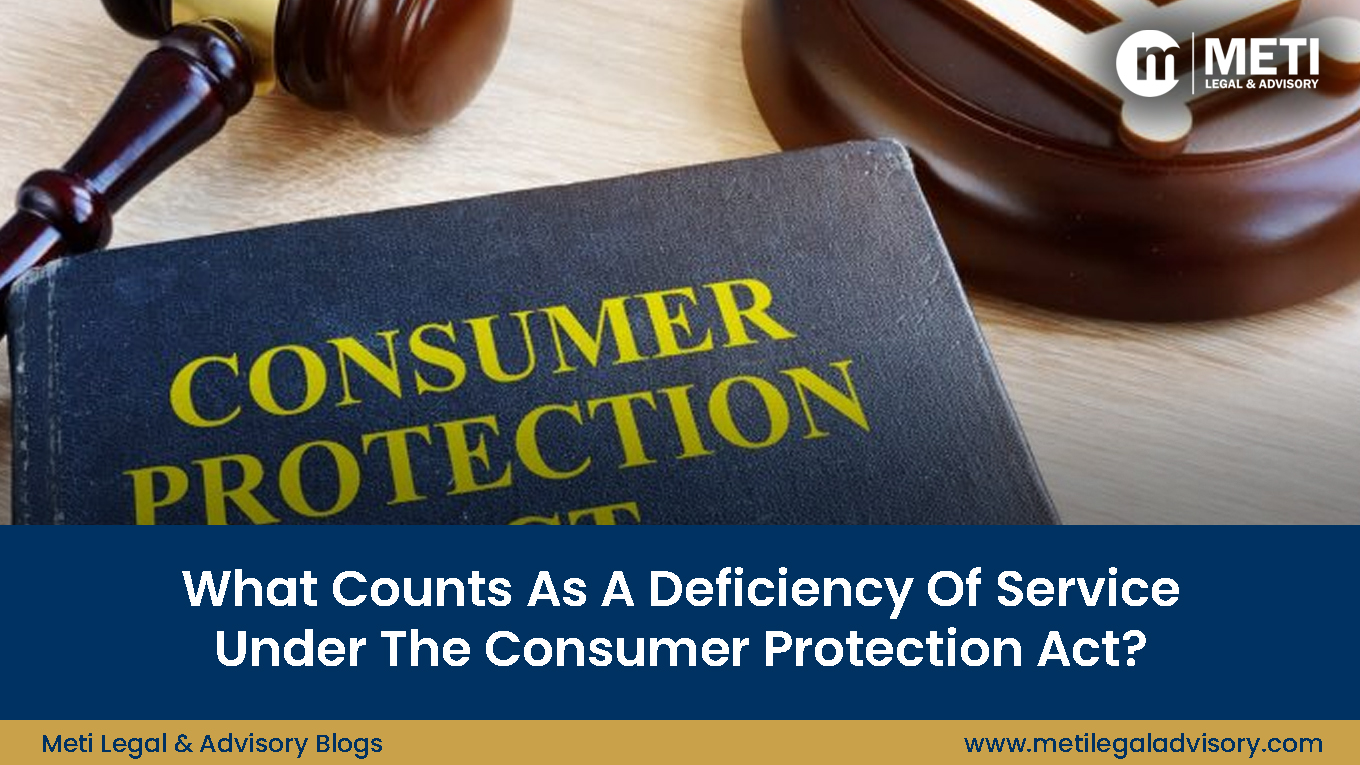
Understanding what legally constitutes a deficiency of service under consumer law.
Introduction
Many people who file consumer complaints make a common mistake. They believe that being unhappy with something they paid for automatically means there was a deficiency of service. However, just feeling dissatisfied is not enough. The law uses a specific test, and if your situation does not meet this standard, your complaint will not succeed, even if your grievance feels genuine.
This is what the law actually says, what it covers, where its limits are, and what it does not include.
The Legal Definition: Section 2(11)
The Consumer Protection Act, 2019 defines deficiency under Section 2(11) as:
| “any fault, imperfection, shortcoming or inadequacy in the quality, nature and manner of performance which is required to be maintained by or under any law for the time being in force or has been undertaken to be performed by a person in pursuance of a contract or otherwise in relation to any service” It specifically includes: (a) any act of negligence or omission or commission by the service provider which causes loss or injury to the consumer (b) deliberate withholding of relevant information by the service provider from the consumer |
Download Consumer Protection Act, 2019
In simple words, a deficiency of service means the people who are supposed to provide a service did not do what they were required to do. They did not give you what they promised. This can happen because they made a mistake, were careless, or failed to do something they should have done. Maybe they even tried to hide something important from you. A deficiency of service occurs when the provider does not deliver what they are legally or contractually required to deliver. This is a problem because the provider failed to do what they were supposed to.
What the Test Actually Asks
Before a consumer forum finds a deficiency of service, it effectively asks three questions:
- Is it a “service” under the Act? Section 2(42) defines service to include banking, insurance, telecom, transport, healthcare, housing, education, entertainment, and more. It excludes free services.
- Was there a standard to be met? Set by law, regulation, or by what the service provider promised in a contract or advertisement.
- Did the provider fall short of that standard? Through fault, negligence, omission, or deliberate concealment.
All three must be answered yes. If your service was free or no identifiable standard was breached, the complaint will likely fail.
What Qualifies: Real-World Examples by Sector
Banking and Financial Services
- Wrongful dishonor of a cheque, particularly when the account has sufficient funds.
- Failure to credit funds or unreasonable delays in processing transactions.
- Bank locker mismanagement. The Supreme Court held in Amitabh Dasgupta v. United Bank of India that banks are liable for deficiencies in locker services when contents go missing.
- Wrongful deduction of charges without consent or proper notice.
Insurance
- The Supreme Court in Gurshinder Singh v. Shriram General Insurance (2020) decided that insurance claims should not be rejected for technical reasons if the delay is explained well.
- Long delays in handling and settling valid claims are not acceptable and need to be resolved quickly.
- Not telling customers about policy exclusions when selling a policy is considered intentionally hiding information.
Healthcare
- Medical negligence: The important case of Indian Medical Association v. V.P. Shantha included medical services under the Consumer Protection Act. This means patients can file complaints against hospitals and doctors for negligent treatment.
- Hospitals or diagnostic centres may sometimes overcharge or commit billing fraud.
- Sometimes, doctors do not explain the risks of a procedure before getting a patient’s consent.
Real Estate and Construction
- Getting possession of a flat or property later than the agreed date, without a valid reason
- Construction defects that do not match the approved plan or agreed specifications
- Not getting the completion certificate or other required approvals that were promised at the time of sale
E-Commerce and Retail Services
- Receiving a product that is very different from what was described or shown online
- Not honouring the warranty or refund policy that was promised when you bought the product.
- Failure to respond to a complaint within 48 hours, as required by the Consumer Protection (E-Commerce) Rules, 2020.
Telecom and Utilities
- Frequent network problems or not providing the service quality promised in the subscription plan
- Disconnecting services without warning or a valid reason
- Charging more than the agreed tariff plan
What Does NOT Count as Deficiency of Service
Many blogs leave out this section, but it is often what readers care about most.
| These situations generally DO NOT qualify Free services: If you did not pay for a service, it is not covered by Section 2(42). The Act only applies when payment is involved. Advocate services: The Supreme Court in Bar of Indian Lawyers v. D.K. Gandhi (2024) decided that advocates are not liable for deficiency of service under the Consumer Protection Act. Legal malpractice must be addressed through other legal channels. Commercial purchases: If you bought a service to resell it or use it in your business, you are not considered a consumer, so the Act does not apply. Pure business-to-business disputes: When both sides are businesses acting commercially, the consumer forum is usually not the right place to resolve the issue. Mere dissatisfaction without breach of standard: Simply being unhappy with a result does not mean there was a deficiency. If the service met the legal standards, it is unlikely to succeed, even if you are disappointed. |
The Standard Shifts by Sector
The definition of deficiency shows that the standard is not the same in every case. It depends on what the law requires or what a contract says must be done. Because of this, the standard for deficiency can change from one situation to another. What counts as a deficiency is always linked to the specific law or contract involved.
| Sector | Where the standard comes from |
| Banking | RBI guidelines, banking regulations, account terms |
| Insurance | IRDAI regulations, policy terms |
| Healthcare | Medical Council norms, duty of care standard |
| Real Estate | RERA 2016, sale agreement, approved building plan |
| Telecom | TRAI regulations, subscription plan terms |
| E-Commerce | Consumer Protection (E-Commerce) Rules, 2020 |
To prove a deficiency, you need to find the specific rule that applies to your situation. This rule could come from a law, a regulation, or the agreement you signed. Simply saying “I expected better” is not enough. You should refer to something concrete, like “The RBI circular says banks must give same-day credit, but they did not.”
Wrapping Up
Deficiency of service is not just any bad experience. Legally, it means you paid for a service, there was a clear standard set by law or contract, and the provider failed to meet that standard because of fault, negligence, omission, or deliberate concealment.
Consumer complaints often fail for a few main reasons: the service was free, the person complaining was a commercial buyer, no clear standard was identified, or, more recently, the service was legal advice, which the Supreme Court has now excluded from the Act.
If your situation meets these requirements, you have a real case. If not, taking it to a consumer forum will likely waste your time. Checking this threshold is more important than most people realise.
| Need Legal Help With a Consumer Dispute? At Meti Legal & Advisory, we help individuals and businesses determine whether their situation constitutes a deficiency of service and file complaints that actually hold up. Visit us at www.metilegaladvisory.com. |
Frequently Asked Questions (FAQs)
Not automatically. The question is whether the provider failed to meet the standard they were legally or contractually required to meet. A doctor who performs surgery that does not produce the desired result has not automatically committed a deficiency because medicine involves inherent uncertainty. But a doctor who was negligent or did not inform you of a known risk likely has.
No. The Supreme Court in Bar of Indian Lawyers v. D.K. Gandhi (2024) held that advocates’ services fall outside the scope of the Consumer Protection Act. For legal malpractice complaints, approach the Bar Council or file a civil suit for negligence.
Yes, if you paid for the service. Government utilities are covered under Section 2(42) of the Act. Wrongful disconnection, excess billing, or persistent supply failure can all constitute a deficiency of service, even when the provider is a government body.
This is a common defence, and consumer forums look at it closely. If the service provider hired a sub-contractor or partner, they are usually still responsible to you as the consumer. Any internal arrangement between the provider and their vendor is for them to resolve, not you.
Yes, charging more than the agreed or displayed price is not allowed. This issue is also considered an unfair trade practice under Section 2(47) of the Act, so you can mention both points in your complaint.
Yes, consumer commissions in India often give compensation for mental agony, harassment, and inconvenience caused by poor service, along with any financial loss. The amount depends on the details of the case, how serious the problem was, and which forum hears it.

Garvita Mishra is a Legal Content Writer at Meti Legal and Advisory. She is law student driven by curiosity and a habit of asking deeper questions about law and society. She enjoys researching across diverse legal fields, translating complex judgments into practical insights, and continuously exploring new areas of law. Through writing and internships, she aims to make legal knowledge more accessible and meaningful.